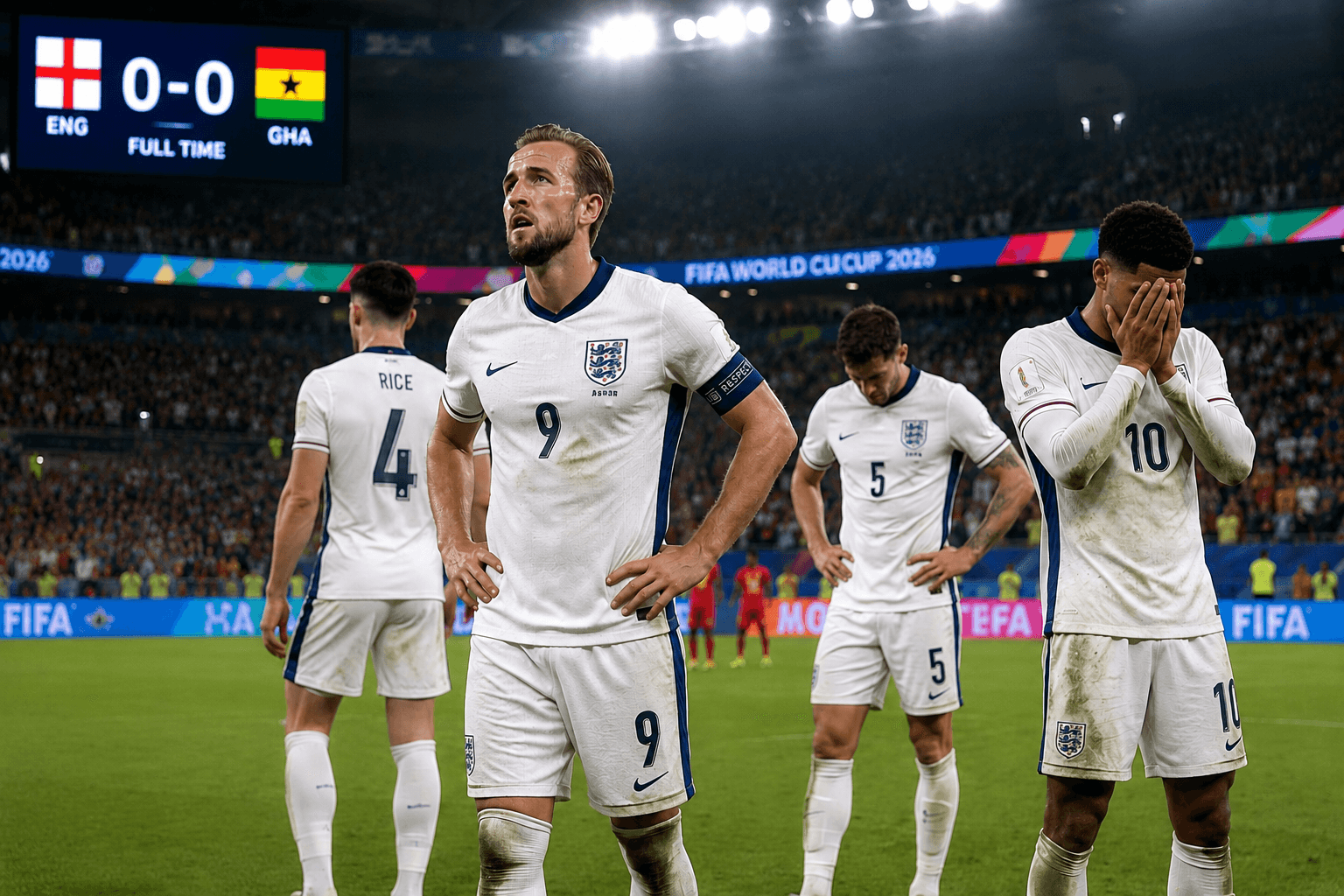
England did not need a crisis. They needed a warning. Ghana gave them one.
After the noise of the Croatia win, England arrived against Ghana carrying something more dangerous than confidence: expectation.
The 4-2 victory over Croatia had been the kind of performance that sends a country into familiar summer fever. Harry Kane was ruthless, Jude Bellingham was powerful, Marcus Rashford added punch, and England looked quicker, sharper and more adventurous than the cautious versions that have so often frustrated supporters at major tournaments.
The reaction was predictable. The flags came out. The old song found its voice again. Football, we were told, might finally be coming home.
Then Ghana happened.
A goalless draw is rarely catastrophic in a World Cup group stage, especially when England still sit in a strong position. But this was not just about the scoreline. It was about what the match revealed. Against Croatia, England were able to attack space, punish transitions and play with rhythm. Against Ghana, they were asked a different question: can you unlock a deep, disciplined, physically strong side when the game slows down and there is no room to run?
The answer was uncomfortable.
Ghana exposed England’s old problem
This was not the free-flowing England of the opening game. This was the England supporters know too well: lots of territory, plenty of shots, long spells of possession, but too few moments of true incision.
Ghana deserve real credit. They did not come to entertain England’s tournament story. They came to disrupt it. Carlos Queiroz’s side defended with patience, narrowed the spaces between the lines and forced England into areas where they looked predictable. They were outshot heavily, but they were not emotionally overwhelmed. They turned the match into a test of England’s imagination, and for too long England could not find enough of it.
That is the first major lesson. Tuchel has made England more aggressive and more vertical, but the low block remains the same old examination paper.
England can run at opponents. They can press. They can hurt teams who open up. But tournament football is not always played in open grass. Sometimes it is played in traffic, with ten bodies behind the ball and the pressure rising with every sideways pass. That is when champions need lock-pickers.
Against Ghana, England had force. They did not have enough subtlety.
The squad omissions were always going to return
This is where the debate around Cole Palmer, Phil Foden, Morgan Gibbs-White and Trent Alexander-Arnold becomes unavoidable.
Tuchel made ruthless calls before the tournament. He wanted balance, structure and clarity. He did not want a squad overloaded with similar creative players. He preferred a group he believed fitted the tactical identity he wanted to build. That logic was defensible before a ball was kicked.
But when England draw 0-0 in a game where one moment of disguise, one reverse pass, one set-piece delivery or one left-footed creative spark could have turned one point into three, those omissions come roaring back into public conversation.
Palmer would have offered calm in tight spaces. Foden would have offered manipulation between the lines. Gibbs-White would have brought direct creativity and the courage to receive under pressure. Alexander-Arnold would have given England elite passing range from deeper areas and the ability to change the angle of attack with one ball.
None of that means Tuchel was automatically wrong. International squads are not fantasy football collections. You cannot take every talented player. Roles matter. Chemistry matters. Fitness and form matter. But Ghana showed the cost of leaving so much invention at home.
The issue is not simply that England missed those players. The issue is that England looked like a side missing a different kind of idea.
Kane needs service, not just faith
Harry Kane has carried England through enough major tournament moments to be above knee-jerk criticism. But against Ghana, he looked isolated for long periods. That is not solely a Kane problem. It is a supply problem.
When Kane drops deep, England need runners beyond him. When he stays high, they need players finding him early. Against Ghana, too many attacks became slow and crowded. Crosses arrived without enough quality. Central combinations broke down. Ghana’s centre-backs were able to defend the box without being pulled apart often enough.
Kane’s late miss will dominate some of the reaction because that is how major tournaments work. Big chances become headlines. But the deeper concern is how long England took to create clear chances in the first place.
A striker of Kane’s level can win knockout games. But even Kane needs England’s structure to give him better service in the moments that matter.
Tuchel’s England are better — but not complete
The danger after the Croatia win was exaggeration. The danger after Ghana is overcorrection.
England are not suddenly a poor team. They are not broken. They are not out of control. They still have elite players, a strong group position and a manager with the tactical experience to solve problems during tournaments.
But they are also not the finished article.
The Croatia game showed their ceiling. The Ghana game showed their floor. That is what makes this team so fascinating. At their best, England can look fast, explosive and full of goals. At their worst, they can still drift into the familiar pattern of sterile dominance: enough control to avoid defeat, not enough craft to guarantee victory.
Tuchel will know this. He is too experienced to panic because of one draw, but he is also too demanding to pretend it was irrelevant. England did not collapse; they stalled. That distinction matters.
The next challenge is not just to beat Panama. It is to show that Ghana was a problem diagnosed, not a warning ignored.
England’s defence deserves some credit
In the noise around England’s attacking frustration, one positive should not be lost: Ghana did not create much.
England were vulnerable against Croatia, conceding twice and showing defensive lapses even in victory. Against Ghana, they were far more secure. That matters in tournament football. The teams that go deep are not always the teams that dazzle every match; they are often the teams that stay alive when the performance is imperfect.
A clean sheet in a difficult group-stage match is not meaningless. It gives England a platform. It means the frustration did not become panic. It means the draw, while disappointing, did not become damaging.
The balance Tuchel is chasing is delicate. England need more creativity without losing control. They need more attacking risk without turning matches into chaos. They need more invention without destroying the defensive structure that gives them tournament stability.
That is the manager’s real puzzle now.
Should England panic? No. Should they worry? A little.
Panic would be ridiculous. England have four points from two games. They beat a strong Croatia side. They remain well placed to qualify. Their final group match gives them a chance to restore momentum and top the group with a performance that calms the national mood.
But concern is reasonable.
The Ghana draw reopened questions that were always sitting beneath the surface. Does Tuchel have enough creativity in the squad? Can England break down low blocks without Palmer, Foden or Alexander-Arnold? Is there enough variety in the attacking patterns? Can Kane be kept involved when opponents deny central space? Can England avoid becoming too dependent on Bellingham driving games through sheer personality?
Those are not panic questions. They are title-contender questions.
Every World Cup winner has a difficult game. Every serious team has a night when the ball does not drop, the passes do not quite connect and the opponent refuses to cooperate. The important thing is what comes next.
The Final Third verdict
England learned that the Croatia performance was not a full answer. It was a glimpse.
They learned that Ghana’s resilience was not an accident but a reminder of how quickly tournament football changes mood. They learned that Tuchel’s squad calls will be judged not in theory, but in the tightest matches, when England need something different from the bench or a new solution from the start.
Most importantly, they learned that control is not enough. To win a World Cup, England need control and cruelty. Structure and surprise. Stability and spark.
Tuchel does not need to rip up the plan. But he does need to sharpen it.
Because if England meet another Ghana in the knockout rounds, there may be no third group game left to fix the conversation.